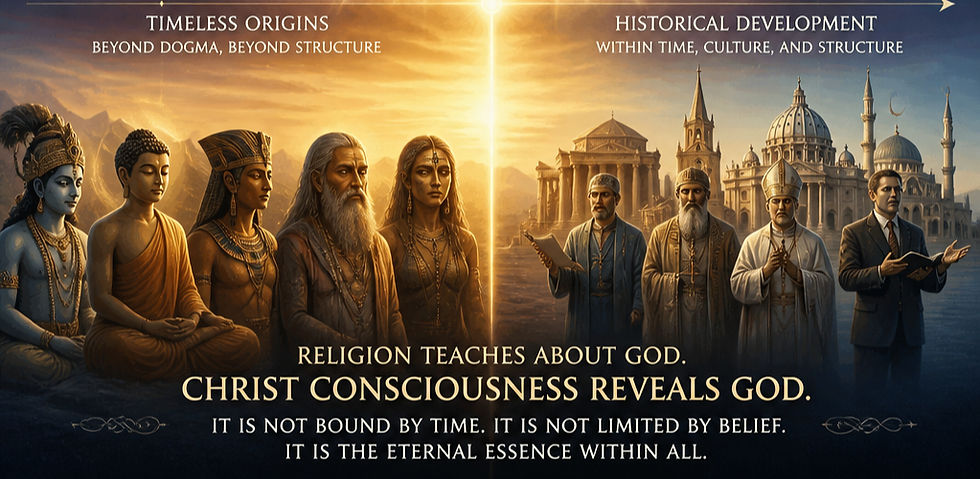
CONSCIOUNESS
REVEALS THE ALL
Christ Consciousness Preceded Religion
Christ Consciousness existed long before the modern concept of religion. It is an eternal, cosmic state of spiritual awareness rather than a doctrine tied to any single historical figure or institutional church. While the term uses the name "Christ," it refers to a universal principle—the realization of divine oneness within the human experience—that has been recognized across ancient cultures for millennia.
The Cosmic Principle Preceding the Man
The word Christ comes from the Greek Christos, meaning "the anointed one." This is a translation of the Hebrew word Mashiach (Messiah). However, long before these linguistic terms emerged, ancient traditions recognized the cosmic reality of an "anointed" or awakened state of being.
Jesus of Nazareth embodied this state, which is why he became known as Jesus the Christ. He did not invent this consciousness; rather, he manifested it to show humanity its own divine potential. In this light, Christ Consciousness is the eternal blueprint of the divine spark hidden within all creation, waiting to be awakened.
Ancient Roots Across Civilizations
Thousands of years before the birth of Christianity, diverse civilizations described this exact same state of unified, elevated awareness under different names:
-
The Vedic Tradition (India): Ancient sages spoke of Krishna Consciousness or Sanatana Dharma (the eternal way). They identified Atman (the individual soul) as being identical to Brahman (the universal divine reality).
-
Ancient Egypt (Kemet): Spiritual initiates worked to achieve the state of Krst (or Karast), which represented the mummified self being transformed and anointed into a divine, eternal being.
-
Buddhism: Centuries before Jesus, Siddhartha Gautama attained the state of Buddha Nature—the universal, unconditioned awareness that is inherent in all sentient beings.
-
Indigenous Traditions: Tribal cultures worldwide lived via a felt connection to the "Great Spirit" or "Original Mind," recognizing a living, breathing intelligence animating all things.
The Shift from Experience to Institution
Religion, in its institutional form, is a later human construct designed to organize, codify, and preserve spiritual experiences. It introduces dogmas, rituals, hierarchies, and boundaries.
In contrast, Christ Consciousness is a direct, boundary-less experience of reality. It is characterized by absolute love, deep compassion, non-duality, and the direct realization that "the Kingdom of God is within you."
When spirituality became institutionalized into rigid religions, the universal invitation to embody this divine state was often replaced by a requirement to worship the historical figures who achieved it.
A Return to the Source
Understanding that Christ Consciousness preceded religion changes how we view spiritual history. It shifts the spiritual journey away from converting to a specific belief system and toward awakening an inherent truth. It suggests that anyone, regardless of their cultural or religious background, can tune into this timeless frequency of unconditional love and unity.
The Eternal Reality: Christ Consciousness Before Religion
Christ Consciousness is an eternal, universal state of divine awareness that predates all organized religion. While the modern world primarily associates the word "Christ" with the historical figure of Jesus of Nazareth and the Christian religion, mystics, esoteric scholars, and ancient traditions view Christ Consciousness as a cosmic reality that has existed since the dawn of creation. It is the foundational blueprint of unified divine intelligence, independent of institutional dogmas, scriptures, or theological structures.
The True Definition of "Christ"
To understand how Christ Consciousness existed before religion, one must separate the term from its modern institutional usage:
-
A Title, Not a Surname: "Christ" was never a last name. It originates from the Greek word Christos, which translates to the Hebrew Hamashiach, meaning "the anointed one".
-
The Cosmic Logos: In metaphysical and mystical philosophy, Christ represents the Logos (the Divine Word or Universal Intelligence) described in ancient texts. It is the perfect ideal of humanity held within the infinite mind of creation.
-
A State of Unified Awareness: Esoteric frameworks define it as the highest state of intellectual development, emotional maturity, and spiritual alignment—a non-dual experience where a soul realizes its complete oneness with the cosmos and the divine creator.


Mystical lineages, such as the ancient Egyptian mystery schools and the pre-Christian Essenes, actively structured spiritual practices around mastering these technologies of consciousness long before they were formalized into church canons.
Historical and Cosmic Precedence
Long before the codification of religion, the underlying principle of Christ Consciousness was recognized, accessed, and named across various ancient cultures and spiritual frameworks.
Tradition /Philosophy
Universal
Concept Name
Core Meaning
The unifying principle holding all matter and creation together.
Ancient Mysticism
The Cosmic Christ /Logos
Hinduism & Vedic Science
Krishna Consciousness
Paramahansa Yogananda noted that "Krishna" (from Jayadev the Krishna) is the Sanskrit equivalent of the Christ state—representing full self-realization.
Buddhism
Buddha Consciousness / Nature
The inherent, unconditioned potential of absoluteawakening and compassion within all beings.
Taoism
The Dao (Tao)
Alignment with the primordial, nameless flow of the universe before concepts split into dualities.

Why Religion Came Later
According to spiritual teachers and historical analyses, consciousness comes first; religion is an afterthought.
When fully self-realised masters incarnate and demonstrate this boundless state of love and unity, they speak directly from a place of pure awareness. However, humanity often struggles to grasp these vast, non-linear realities directly.
Religion emerges when subsequent generations attempt to codify, institutionalise, and preserve the memories of those masters. In doing so, mystical, direct experiences of the "kingdom within" are frequently replaced by historical dogmas, rigid rituals, and exclusive claims to truth.
Accessing the Universal Inheritance
Because Christ Consciousness is a natural cosmic law rather than an institutional privilege, it remains fully accessible to any individual, completely independent of their religious or non-religious affiliation.
To explore this concept further, seekers often reference foundational works such as Paramahansa Yogananda's Self-Realization Fellowship teachings or the historical and esoteric readings provided by The Edgar Cayce Readings, which detail how Jesus mastered this universal path as a pattern for all of humanity to follow.
Ultimately, Christ Consciousness asserts that divinity is not an external force to be worshipped from a distance, but an internal reality waiting to be awakened within the heart of every soul.