Universal Psychological Laws
Practical Psychology
Here at Universal Laws and Mind we bridge the gap between abstract cosmic concepts and actionable behavioral science. practical psychology, you can bridge demystifying "magical thinking" and replacing it with cognitive frameworks you can test immediately. Here are the universal psychological laws that govern human behavior.
Practical Psychology
1. Laws of Attention & Cognitive Focus
-
The Law of Requisite Variety: Originating in cybernetics but vital to psychological resilience, this law states that the element within any system that has the most flexibility will ultimately control the system. In practical psychology, the person with the most adaptable mindset and diverse responses always wins the conflict or navigates the crisis successfully.
-
The Law of Cognitive Contrast: This law dictates that our minds do not evaluate things in isolation; we judge everything based on immediate comparison. If you experience something highly negative first, a mediocre outcome suddenly feels like a massive win. Mastering this allows readers to intentionally shift their baseline of gratitude and satisfaction.
-
The Law of Facilitation: This law states that when a thought or behavior pattern is repeated, the neural pathways become stronger, reducing resistance each subsequent time. It is the literal biological mechanics behind how "thoughts become things," showing that habit formation is simply the mind optimizing for efficiency.
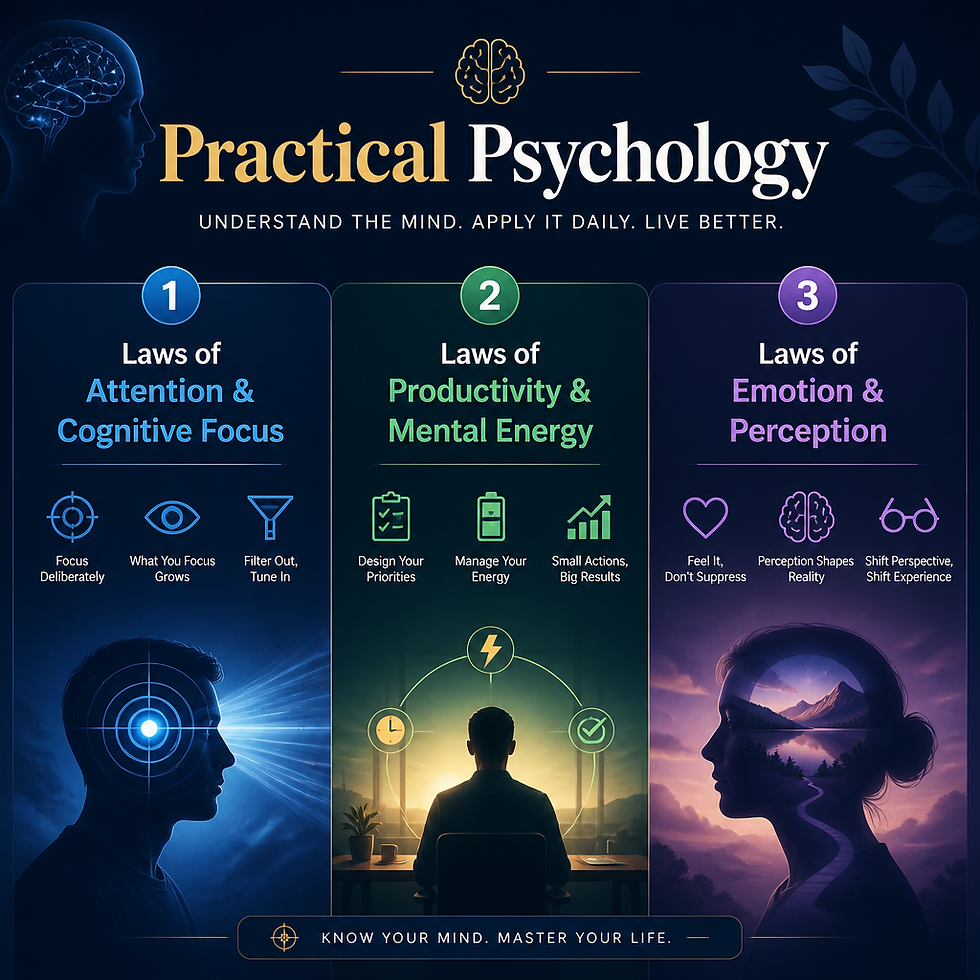
2. Laws of Productivity & Mental Energy
-
Parkinson’s Law: This law states that work expands to fill the time available for its completion. If you give yourself a week to complete a two-hour task, the mind will psychologically complicate the task to fill the week. It is a vital law for understanding focus, boundaries, and manifestation timelines.
-
The Law of Diminishing Intent (The 72-Hour Rule): This psychological law states that the longer you wait to take action on an idea, spark of inspiration, or desire, the less likely you are to ever do it. Emotionally, the energy dissipates, and the subconscious mind categorizes the idea as "unimportant," killing momentum.
-
The Law of Psychological Reactance: When people feel their freedom or choices are being threatened or restricted, an intense internal drive is triggered to rebel and reclaim that freedom. This explains why strict deprivation diets fail, why forbidden desires become obsessions, and how forced affirmations can cause internal resistance.
3. Laws of Emotion & Perception
-
The Law of Affective Forecasting: Human beings are universally terrible at predicting how they will feel in the future. We consistently overestimate the long-term emotional impact of both good events (winning the lottery) and bad events (a breakup). Teaching this law helps readers practice detachment from future outcomes.
-
The Law of Emotional Contagion: This law proves that emotions are literally infectious. Because of mirror neurons in the brain, we automatically mimic and synchronize our expressions, vocalizations, and postures with those around us. If anyone change their environment and company, their internal "vibration" or mood shifts automatically.
Mapping the Cognitive Shift
Psychological Law Abstract Spiritual Equivalent The Practical Psychology Explanation
Repeated thoughts physically re-wire the brain's pathways for easier access
Law of Requisite Variety
Law of Perpetual Transmutation
Flexibility and adaptability yield total control over one's environment
Parkinson's Law
Divine Timing / Manifestation
The mind uses constraints to create focus; endless time breeds procrastination.
Psychological Reactance
Law of Polarity (Resistance)
Forcing the mind to do something creates an equal and opposite urge to rebel.
Law of Facilitation
Law of Vibration
Here are the universal psychological laws perfectly suited for mindfulness beginners, framed in warm, accessible language:
1. Laws of Mindful Awareness & Presence
-
The Law of the Garbage Truck: Developed by psychologist David J. Pollay, this law states that many people run around full of "garbage"—frustration, anger, and disappointment. As their pile accumulates, they look for a place to dump it. Mindfulness beginners learn that when someone dumps negativity on them, it isn't personal. The practice is simply to smile, wave, wish them well, and move on without absorbing the trash.
-
The Law of Habituation: This law states that the human brain naturally stops noticing stimuli that remain constant over time. It explains why we stop noticing the sound of a ticking clock, but also why we stop noticing the beauty of our daily lives. Mindfulness is the deliberate act of breaking habituation—waking up the brain to experience the present moment as if seeing it for the very first time.
-
The Law of the Present Instant: The mind can only actually experience stress, anxiety, or regret when it leaves the current room and travels into the future or the past. This law dictates that in the exact, micro-second of the absolute present, suffering cannot exist. Beginners learn that mindfulness isn't about clearing the mind for an hour; it is just returning to this single breath, right now.
2. Laws of Self-Compassion & Emotional Flow
-
The Law of Emotional Transience (The 90-Second Rule): Formulated by neuroanatomist Dr Jill Bolte Taylor, this law reveals that when an emotion is triggered, the chemical flush lasts in the body for only 90 seconds. If a reader feels angry or anxious for longer than that, it is because their thoughts are actively refueling the loop. This gives beginners a beautiful, tangible anchor: they only ever have to ride out a difficult emotion for a minute and a half.
-
The Law of Non-Resistance: This law states that psychological pain multiplies the moment we fight or judge it (Pain × Resistance = Suffering). If a beginner feels anxious during meditation and gets angry at themselves for being anxious, they double their distress. Mindfulness teaches them to say, "Ah, anxiety is here," allowing it to pass through without sticky resistance.
-
The Law of Mental Space: Just as a physical room can only hold so much furniture, the conscious working memory can only hold a few bits of information at once. When a beginner's mind is cluttered with a massive to-do list, they experience chronic overwhelm. Mindfulness serves as the daily practice of "decluttering the room," choosing to hold just one beautiful, intentional focus at a time.
Framing It for Beginners
The 90-Second Rule
"I'm going to feel this anxious forever."
Emotions are just brief physical waves; I just need to breathe through the 90-second flush.
Law of Non-Resistance
"I'm bad at meditation because my mind won't quiet down."
Thinking is what minds do. I can notice the thoughts without fighting them.
Law of Habituation
"My daily routine is completely boring and draining."
I've just gone on autopilot. I can use my senses to find three new details right now.
Law of the Garbage Truck
"Why is everyone so rude and out to get me today?"
Their mood is their own heavy cargo. I don't have to catch it or carry it.
The Psychological Law What the Beginner Feels The Mindful "Aha!" Moment
The 5-Day Mindful Mindset Challenge: Reset Your Internal Blueprint
Challenge Overview
-
Target Audience: Beginners struggling with overthinking, daily stress, and mental fatigue.
-
Core Philosophy: Stop trying to "empty" your mind. Learn the psychological laws that govern it so you can work with your brain, not against it.
-
Daily Commitment: Under 10 minutes (a 3-minute concept read + a 5-minute practical exercise).

Day 1: The 90-Second Micro-Reset
-
The Universal Law: The Law of Emotional Transience (The 90-Second Rule)
-
The Core Lesson: When you feel a sudden surge of stress, anger, or anxiety, it only takes 90 seconds for those chemicals to flush completely out of your bloodstream. If the feeling lasts longer, it is only because your loop of thoughts is actively refueling it.
-
The Daily Action: The next time a stressful trigger occurs today, do not fight it or overanalyze it. Set a silent mental timer for 90 seconds. Simply close your eyes (if safe) and focus exclusively on the physical sensation of your breath until the chemical wave passes.
Day 2: Waking Up the Brain
-
The Universal Law: The Law of Habituation
-
The Core Lesson: The brain naturally goes on autopilot and stops "seeing" anything that stays constant. This causes us to live in our heads, completely missing the beauty and peace available in our everyday environments.
-
The Daily Action: Break the autopilot loop during a routine activity today (like washing the dishes, drinking your morning coffee, or walking to your car). Engage all five senses. Notice three tiny visual details, textures, or scents you usually completely ignore.
Day 3: Dropping the Shield
-
The Universal Law: The Law of Non-Resistance
-
The Core Lesson: Psychological distress multiplies the exact moment we judge it or fight it (Pain × Resistance = Suffering). Forcing yourself to "stop thinking" or getting angry at your anxiety only makes the mental chaos twice as loud.
-
The Daily Action: Sit quietly for 5 minutes. When a distracting thought or uncomfortable emotion arises, do not try to push it away. Instead, mentally nod to it and silently say, "Ah, there is anxiety," or "There is a thought about tomorrow." Watch it pass by like a cloud without engaging with it.
Day 4: Return to the Single Room
-
The Universal Law: The Law of Mental Space
-
The Core Lesson: Your conscious working memory is like a small physical room; it can only hold a few items before becoming completely cluttered and overwhelmed. True presence means choosing to put down the heavy cargo of the past and future.
-
The Daily Action: Whenever you feel overwhelmed today, pause and ask yourself: "What is required of me in this exact micro-second?" Shrink your universe down to just the single task right in front of you—whether that is typing one email, taking one step, or listening to one sentence.
Day 5: Letting the Trucks Pass
-
The Universal Law: The Law of the Garbage Truck
-
The Core Lesson: Many people walk around full of accumulated emotional "garbage"—frustration, stress, and moodiness. When they dump it on you, it isn't a reflection of your worth; they are simply looking for a place to unload their heavy cargo.
-
The Daily Action: Protect your peace today. If a coworker, driver, or family member drops a wave of negativity or bad attitude in your direction, do not take it personally or catch the trash. Take a deep breath, smile, wish them internal peace, and consciously step out of their way.
Challenge Summary for You!
Day The Universal Law Daily Action Focus The Goal
Day 1 90-Second Rule Ride out emotional waves without Emotional freedom.
overthinking.
Day 2 Law of Habituation Use your 5 senses during a routine task. Breaking autopilot.
Day 3 Law of Non-Resistance Acknowledge thoughts without judging them. Ending mental friction.
Day 4 Law of Mental Space Focus strictly on the absolute present Curing overwhelm.
micro-second
Day 5 Law of the Garbage Refuse to absorb other people's Protecting energy.
Truck negative moods.
5-Day Mindful Mindset Challenge pdf
It strips out complex jargon and translates abstract spiritual mechanics into actionable cognitive shifts—including The 90-Second Rule, The Law of Habituation, and The Law of Non-Resistance—concluding with a clean Challenge Blueprint Matrix table for easy reference.
Click on picture for your (pdf download)


-
"Acknowledging that your future exists as a cloud of infinite possibilities is only the first step. To bring one of these timelines into your physical reality, you must introduce a conscious observer. Read our next deep-dive on How Focus Collapses the Quantum Wave to discover how your daily attention acts as the exact mechanism that hardens abstract energy into solid matter."