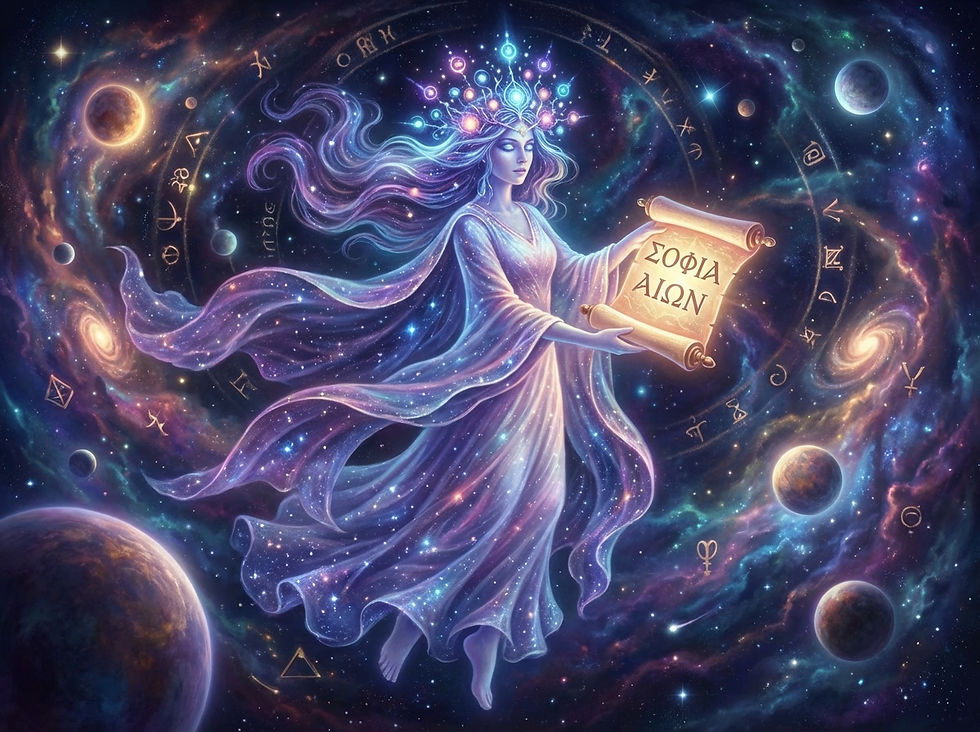
Sophia

Sophia Introduction
According to the Gnostic story,
Sophia desired to know the Light more deeply.
She reached out toward the unknowable Source without the guidance of her divine counterpart.
This action was not sinful, but it was unbalanced. Her desire to understand the
Light on her own caused her to fall from the Pleroma into the lower realms. These lower realms are called the aeons and beneath them, the chaotic worlds of matter and illusion.
As Sophia descends, she finds herself surrounded by dark forces that try to steal her light.
These are the archons, beings who govern the material world. In this state of fall, Sophia becomes trapped. She forgets her origin. She cries out in sorrow and repentance,
seeking the Light she once knew. This fall is not about punishment. It is about separation—a movement away from unity and into fragmentation.
The fall of Sophia is a symbol. It represents the journey of the soul itself. Each human soul begins in the realm of spirit, close to the Source. But like Sophia,
the soul becomes curious. It reaches into the material world and gradually becomes attached to it. Over time, the soul forgets its divine origin. It becomes
entangled in the illusions of the physical world—suffering, desire, fear, and separation.
Sophia’s story is not a historical event.
It is a spiritual teaching wrapped in myth.
It speaks to something that happens within each of us.
When we are born into this world,
we carry within us a spark of the divine. But as we grow,
we become distracted. We
identify with our body, our thoughts, and the outer world.
We begin to believe that this material existence
is all there is.
Like Sophia, we fall into forgetfulness.
Yet, the story also shows us something important.
Even in her fallen state,
Sophia remembers the Light. She cries out to it. She longs for it. This longing is the beginning
of the return. In each of us, there is a similar longing. We may not always recognize it, but it shows up as a sense that something is missing, a desire for something higher, something true.