Thoth Through the Ages Ancient Wisdom and Its Lasting Impact on Humanity
A figure with the head of an ibis, a pen in hand, and the moon over his crown still speaks to a modern question: what happens when knowledge becomes sacred?
Thoth was not just another god in the long, rich world of ancient Egypt. He stood at the meeting point of language, time, judgement, magic, science, and memory. To the Egyptians, he was the divine scribe who recorded the verdicts of the dead, measured the heavens, guarded sacred words, and gave structure to knowledge itself.
Across thousands of years, Thoth changed names and meanings. He became linked with the Greek god Hermes, inspired Hermetic philosophy, entered medieval alchemy, shaped occult traditions, and still appears in modern discussions of consciousness and spiritual wisdom.
Some of what people say about Thoth today comes from ancient Egyptian religion. Some comes from later Greek, Arabic, European, and modern esoteric traditions. The most useful way to understand him is to follow both paths, the historical Thoth and the symbolic Thoth, without confusing one for the other.
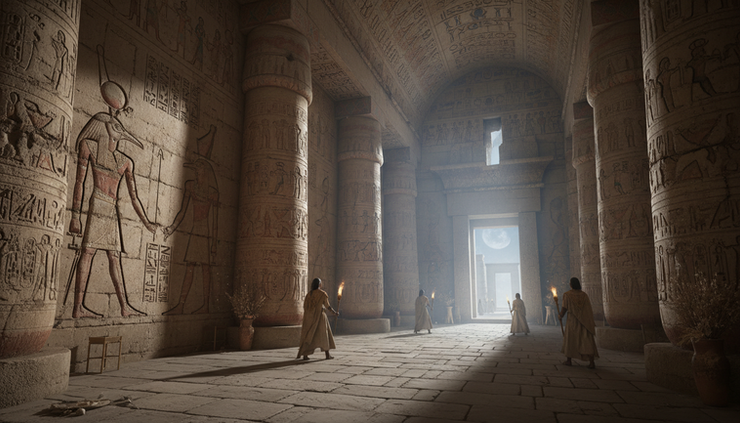
Thoth began as a keeper of order in ancient Egypt
In ancient Egyptian belief, the universe needed balance. That balance was known as maat, a word that can mean truth, justice, harmony, and right order. Thoth belonged deeply to that world of balance.
He appeared in Egyptian religion from very early periods and remained important for much of Egypt’s ancient history. His main cult centre was Hermopolis, known to the Egyptians as Khmunu. In art, he often appeared in two forms:
As a man with the head of an ibis
As a baboon, an animal associated with the moon and sacred observance
Both forms mattered. The ibis, with its long curved beak, may have suggested the shape of a writing reed or the crescent moon. The baboon was linked to the dawn, the moon, and ritual gestures.
Thoth’s roles were many, but they all connect to one central idea: the universe can be known, named, measured, and preserved.
He was the god of writing. He was patron of scribes. He recorded divine decisions. He measured time. He had lunar associations, which made him a natural figure for calendars and cycles. He also appeared in myths as a mediator and healer, using skill, language, and wisdom to repair what conflict had broken.
In the myth of Osiris, Isis, and Horus, Thoth often appears as a restorer of order. When Horus is injured, Thoth helps heal him. When gods argue, Thoth can serve as a reasoned voice. When truth must be recorded, Thoth is present as the scribe.
That made him essential in the afterlife.
In the famous weighing of the heart, the heart of the deceased was weighed against the feather of maat. If the heart was balanced, the person could pass into the blessed afterlife. If not, the soul faced destruction. In many depictions, Thoth stands nearby, recording the result.
This image says a great deal about Egyptian values. The universe was not random. A life could be weighed. Truth could be measured. Memory mattered. And writing was not just practical, it was sacred.
For a society that relied on agriculture, law, ritual, astronomy, and administration, the scribe was more than a clerk. The scribe helped preserve civilisation. By making Thoth the divine patron of scribes, Egyptian religion gave written knowledge a spiritual dignity that still feels familiar today.
Writing was sacred because words shaped reality
Modern people often treat writing as a tool. Ancient cultures often treated it as power.
For the Egyptians, words could do more than describe the world. Words could act upon it. Ritual speech, names, spells, hymns, and inscriptions held force. To know the true name of a thing was to have a kind of access to its essence.
This is one reason Thoth also became associated with magic. Not stage magic, but divine skill: the hidden knowledge of names, formulas, timing, symbols, and correct speech.
In Egyptian funerary texts, words guide the dead through dangerous spiritual regions. Tomb inscriptions preserve identity. Temple carvings renew cosmic order. Written signs are not passive marks. They participate in the sacred system of life, death, and renewal.
Thoth, as master of words, stands behind that system.
His link with the moon also deepens this meaning. The sun blazes. The moon measures. It waxes, wanes, disappears, and returns. Ancient people used lunar cycles to track time, rituals, and natural rhythms. Thoth’s lunar aspect helped connect him with calculation, calendars, and the measured order of the cosmos.
This gave Thoth a rare range. He was not only a god of books. He was tied to the pattern behind events.
That pattern shows up in three enduring themes:
Knowledge requires discipline.
Thoth is not a god of careless curiosity. He represents trained attention, careful record keeping, and the exact use of language.
Wisdom serves balance.
His knowledge is not separate from maat. Learning has an ethical purpose. It supports truth, justice, and right relationship.
Memory protects civilisation.
What is not recorded can vanish. Thoth preserves decisions, names, rituals, and histories.
These themes help explain why Thoth remained powerful long after the temples of Egypt changed, closed, or fell into ruin.

Thoth became Hermes Trismegistus in the Greek and Roman world
When Greek culture spread through Egypt, especially after Alexander the Great and under the Ptolemies, Egyptian and Greek religious ideas began to blend. The Greeks identified Thoth with Hermes, their messenger god associated with language, travel, boundaries, interpretation, and cleverness.
From this blending came Hermes Trismegistus, meaning “Hermes the Thrice-Great.” He was not simply the Greek Hermes and not simply the Egyptian Thoth. He became a legendary sage, a master of divine knowledge, astrology, philosophy, and sacred science.
This is where Thoth’s later influence grows in a new direction.
Texts attributed to Hermes Trismegistus became known as Hermetic writings. The most important of these include the Greek and Latin texts often grouped under the name Corpus Hermeticum, along with other works on astrology, alchemy, and spiritual knowledge.
These writings were not composed in the earliest periods of ancient Egypt. Many scholars place key Hermetic texts in the first centuries of the Common Era, in the culturally mixed world of Greek and Roman Egypt. They reflect Egyptian, Greek, Platonic, Stoic, Jewish, and other influences.
That matters because many modern claims describe Hermetic teachings as if they were direct transcripts from prehistoric Egypt. The truth is more interesting. They are part of a long chain of interpretation, where Egyptian symbols, Greek philosophy, and spiritual practice met.
The Hermetic texts ask large questions:
What is the nature of the divine?
How does the mind relate to the cosmos?
Can human beings know higher reality?
What is the link between the visible and invisible worlds?
How should a wise person live?
The famous phrase “as above, so below” is often linked with Hermetic thought, especially through the later tradition of the Emerald Tablet. The idea suggests a correspondence between the macrocosm and the microcosm, between the cosmos and the human being.
This became one of the most influential spiritual ideas in Western esotericism. It shaped alchemy, astrology, Renaissance magic, occult philosophy, and later alternative spirituality.
The ancient Egyptian Thoth was a god. Hermes Trismegistus became a revealed teacher. Together, they formed one of history’s most enduring images of wisdom: the sacred scribe who understands the hidden order of reality.
The teachings linked to Thoth shaped alchemy, philosophy, and esoteric thought
By the Middle Ages and Renaissance, Thoth’s influence travelled far from Egypt.
Hermetic and alchemical texts moved through Greek, Syriac, Arabic, Latin, and European intellectual worlds. Scholars, mystics, physicians, and alchemists read works attributed to Hermes Trismegistus and treated them as remnants of very ancient wisdom.
During the Renaissance, European thinkers became deeply interested in Hermetic writings. Some believed these texts preserved knowledge older than Plato and Moses. Later scholarship showed that many of the key texts were younger than Renaissance readers thought, but their influence had already taken root.
Hermetic ideas shaped several fields.
Alchemy
Alchemy was not only an early form of chemistry. It also used metals, fire, purification, and transformation as symbols for inner change. The Hermetic image of hidden laws in nature suited alchemy perfectly.
Astrology
Hermetic thought supported the idea that celestial patterns and earthly life reflected one another. This strengthened traditions that looked for meaning in planetary cycles.
Ritual magic
Thoth’s old link with sacred words survived through grimoires, invocations, divine names, and symbolic systems. In these traditions, language still acted as a bridge between human and divine realms.
Philosophy of mind and cosmos
Hermetic writings often present the human mind as capable of rising toward divine understanding. The world is not seen as dead matter, but as alive with intelligence and meaning.
In the nineteenth and twentieth centuries, groups interested in occultism, ceremonial magic, Theosophy, and modern esotericism revived Thoth and Hermetic symbols again. The early twentieth-century text The Kybalion also popularised a set of “Hermetic principles,” though it is a modern work rather than an ancient Egyptian text.
This distinction does not make it worthless. It simply places it in the right period.
Modern spiritual culture often blends ancient Egyptian imagery, Hermetic philosophy, meditation, tarot, astrology, and self-development. Thoth often appears in this space as a symbol of awakened intelligence, sacred writing, and hidden knowledge.

Thoth still affects how people think about knowledge today
Thoth’s lasting impact is not only found in occult books or museum galleries. His image still speaks because his core themes remain human concerns.
People still ask how knowledge should be used. They still worry about truth, memory, language, and power. They still sense that writing changes the world.
The teachings connected with Thoth continue to influence humanity in several clear ways.
He reminds us that knowledge carries responsibility
Thoth was never only clever. He was wise because his knowledge served order.
That idea feels urgent now. Data, artificial intelligence, genetic science, media systems, and digital archives all raise the same question in modern form: does knowledge serve truth and balance, or does it serve confusion and control?
The Egyptian image of Thoth recording the judgement of the heart offers a strong symbol. Every action leaves a record. Every society must decide what it values. Every system of knowledge needs an ethical centre.
He keeps the sacred value of writing alive
To write something down is to resist disappearance.
Ancient scribes knew this. Every inscription, temple text, legal record, and funerary spell was an act of preservation. Today, writing still carries that force, even when it appears on screens rather than papyrus.
Personal journals, archives, books, constitutions, scientific papers, family histories, and oral traditions written down all serve a Thoth-like function. They protect memory from time.
Thoth shows that literacy is not a small skill. It is a civilisational power.
He offers a model of balance between reason and mystery
Modern culture often splits reason and spirituality into opposing camps. Thoth does not fit that split.
He measures, calculates, records, and judges. He also heals, speaks sacred words, and moves through divine realms. He belongs to both the rational and the mystical.
That balance helps explain why Thoth remains attractive. He gives symbolic form to a kind of intelligence that does not flatten wonder. He suggests that careful thought and reverence can exist together.
This does not mean every modern claim made in Thoth’s name is historically sound. Some are speculative. Some are modern inventions. Some are creative spiritual interpretations rather than ancient teachings.
Still, the symbolic value remains. Thoth invites a disciplined search for meaning, not a careless leap into fantasy.
He shaped the Western search for hidden order
Hermetic ideas linked with Thoth encouraged people to see patterns across levels of reality. Body and cosmos. Mind and nature. Word and world. Symbol and truth.
This way of thinking influenced alchemy, Renaissance philosophy, occult traditions, depth psychology, and modern spiritual literature. Even when people reject supernatural claims, the habit of looking for meaningful patterns remains powerful.
At its best, this tradition teaches humility. The visible world may not be the whole story. Human beings may need symbols, myths, and contemplative practice to understand themselves.
At its worst, it can slide into false certainty. Pattern-seeking can become conspiracy thinking if it loses evidence and self-criticism.
A mature reading of Thoth holds both lessons: seek deeper order, but keep the scribe’s discipline.

The real legacy of Thoth is the union of memory, truth, and transformation
Thoth has survived because he is more than a figure from one ancient religion. He is a symbol of what humans hope knowledge can become.
In ancient Egypt, he helped maintain maat. He gave divine status to writing, measurement, ritual speech, and judgement. In the Greek and Roman world, he merged with Hermes and became Hermes Trismegistus, the legendary teacher of sacred philosophy. In alchemy and Western esotericism, he became a guide to transformation. In modern thought, he still stands for the search to connect language, mind, cosmos, and conscience.
The historical Thoth and the later Thoth are not identical. One belongs to Egyptian temples, scribes, myths, and funerary beliefs. The other belongs to Hermetic writings, alchemical workshops, occult orders, and modern spiritual imagination.
Yet they share a clear centre: knowledge is never neutral when it shapes the soul and society.
That is why Thoth still matters. He asks every age to take words seriously. He asks seekers to combine curiosity with discipline. He asks cultures to remember that truth must be recorded, protected, and lived.
The ibis-headed scribe still stands at the edge of the scales, pen ready, watching what humanity chooses to write next.
In my research of words and spelling ("spell"-ing) I think we still don't fully grasp the power that words may have.
What do you think?
Leave me a comment!


Comments